
Updated:
October 3, 2026
•
Reviewed by Dr. Tina Jenq, MD, Board-Certified Plastic Surgeon
I’m Dr. Tina Jenq from Oregon Cosmetic and Reconstructive Clinic. Many patients come to me with a small bump or lump beneath the skin and ask, “What is this—and do I need to worry?” That is a great question.
Most of these growths are harmless. However, moles, lipomas, and sebaceous cysts can sometimes look or feel similar. Understanding their common differences can help you know what may be happening beneath your skin and what kind of skin lump removal or treatment may make sense.
Explore Our Skin Procedure Offerings
Learn about mole removal, cyst and lipoma treatment, scar care, skin resurfacing, and other in-office skin procedures available at our Happy Valley clinic.
Comparing Moles, Lipomas, and Sebaceous Cysts
These common skin growths can look or feel similar. The features below provide a general comparison, but an in-person examination is the most reliable way to identify an unfamiliar lump or growth.
| Feature | Mole | Lipoma | Sebaceous Cyst |
|---|---|---|---|
| Typical Feel | Usually firm. A mole may be flat, slightly raised, or dome-shaped. | Usually soft or rubbery and often moves beneath the skin. | Usually firmer and more closely attached to the skin. It may have a visible central opening. |
| Location | On the surface or within the upper layers of the skin. | Within the fatty tissue beneath the skin. Some lipomas extend more deeply. | Within the skin or immediately beneath it. |
| Growth Pattern | Often remains stable or changes gradually over time. | Usually grows slowly over several months or years. | May remain stable but can enlarge quickly when inflamed. |
| Pain or Irritation | Usually painless unless it is repeatedly rubbed or irritated. | Usually painless, although a larger lipoma may create pressure. | May become tender, red, swollen, or painful when inflamed. |
| Common Treatment | Observation, shave removal or surgical excision, depending on the mole and the treatment goal. | Observation or surgical removal when it grows, causes pressure, creates discomfort, or becomes a cosmetic concern. | Surgical removal of the cyst wall and surface opening to reduce the chance of recurrence. |
Scroll right to see the full comparison →
Moles: Small Clusters of Skin Cells
A mole forms when pigment-producing skin cells grow together instead of spreading evenly throughout the skin. Moles usually sit on the surface or within the upper layers of the skin.
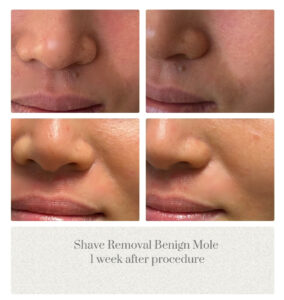
Moles may be:
- Round or oval
- Light brown, dark brown, pink, or skin-colored
- Flat, slightly raised, or dome-shaped
Over time, a flat mole may become more raised. Most moles are benign. However, it is important to have a mole checked if you notice changes in its color, border, shape, size, or surface.
A mole that begins bleeding without a clear injury, develops an irregular border, or changes rapidly should also be evaluated.
At Oregon Cosmetic and Reconstructive Clinic, mole removal is performed in-office. Depending on the mole’s characteristics, Dr. Jenq may recommend shave removal or excision. Both approaches aim to remove the growth with minimal scarring and a comfortable recovery.
Lipomas: Soft Lumps Beneath the Skin
A lipoma is a benign growth made from fat cells. Unlike a mole, a lipoma grows beneath the skin, usually within the fatty layer. Some lipomas can also develop beneath a muscle.
Lipomas usually feel:
- Soft or rubbery
- Movable when gently pressed
- Slow-growing
- Painless, although larger lipomas may cause pressure or discomfort
Small, superficial lipomas can often be removed in the clinic, depending on their size and location. A deeper lipoma beneath a muscle may require a more involved procedure.
In those cases, I make a careful incision, remove the growth, and repair the deeper tissue or muscle layer. Recovery is usually straightforward, and many patients return to most normal daily activities within a few days.
📍 Serving the Portland metro area: Our clinic is located in Happy Valley and welcomes patients from Portland, Lake Oswego, Clackamas, and surrounding communities for lipoma and skin lump removal. View our location and directions →
Sebaceous Cysts: Clogged Follicles Beneath the Skin
A sebaceous cyst forms when a follicle or skin structure becomes blocked. As material builds up, it creates a smooth, rounded lump beneath the skin.
A cyst may have a small central opening called a punctum.

Although the opening appears on the skin, the cyst wall extends more deeply. To reduce the chance that the cyst returns, removal usually includes both the surface opening and the complete cyst wall beneath the skin.
These minor procedures can often be performed in the clinic with local anesthesia. Patients usually experience mild aching for a day or two, which they can often manage with Tylenol.
Depending on the size and location of the cyst, many patients can resume cardio exercise after about three days. I provide more specific activity instructions after the procedure.
🔗 Also at OCRC: If you have concerns about post-surgical swelling, firmness, or scar changes after a previous skin procedure, Dr. Jenq offers dedicated evaluations for these concerns as well.
When Should You Have a Skin Lump Evaluated?
It is worth having a lump examined if you notice:
- Rapid growth
- Increasing pain or tenderness
- Redness, warmth, or drainage
- A change in color, shape, or surface
- A lump that feels fixed rather than movable
- A growth that catches on clothing or interferes with activity
- A cosmetic concern that makes you feel self-conscious
When to See a Specialist for Skin Lump Removal in Portland
At Oregon Cosmetic and Reconstructive Clinic, I perform detailed assessments to determine what type of growth you may have and whether observation, imaging, biopsy, or removal makes sense.
Although many moles, lipomas, and cysts are benign, an examination provides more reliable information than appearance or texture alone.
Understanding what is beneath your skin can help you make a confident, informed decision about your care. To learn more about all skin procedures available at our clinic, including mole removal, cyst removal, and scar treatment, visit our skin procedures page.
Have a Mole, Cyst, or Lump You Would Like Evaluated?
Skip the phone tag. Text our team to schedule a skin consultation with Dr. Tina Jenq at our Happy Valley clinic.
Text Us at 503-400-6622
View Location & Office Hours →
Serving Portland, Clackamas, Lake Oswego, and nearby communities.
Frequently Asked Questions About Moles, Lipomas, and Cysts
How can I tell the difference between a lipoma and a sebaceous cyst?
A lipoma usually feels soft or rubbery and often moves beneath the skin. A sebaceous cyst is often firmer and more closely attached to the skin. A cyst may also have a small central opening called a punctum, while a lipoma does not. An in-person examination is the most reliable way to confirm which type of growth you have.
Can a cyst develop beneath a mole?
Yes. A mole may sit on the surface while a cyst forms in a follicle beneath it. This can make the mole appear more raised or create a firm lump underneath. A new or changing lump should always be examined to confirm the cause.
Is a fatty tumor the same as a lipoma?
Yes. “Fatty tumor” is a common term for a lipoma. Lipomas are generally benign and slow-growing. Some patients choose skin lump removal because a lipoma causes pressure, catches on clothing, becomes noticeable, or creates a cosmetic concern.
Can moles, lipomas, and cysts be removed in the office?
Many smaller and more superficial growths can be removed in the clinic with local anesthesia. Larger or deeper growths may require a more involved procedure. Dr. Jenq determines the best approach after examining the size, depth, and location of the growth. Learn more about our in-office skin procedures in Portland.
When should I see a surgeon in Portland for a skin lump?
Arrange an evaluation if a lump grows rapidly, becomes painful or red, changes in appearance, feels unusually firm, or is difficult to identify. You may also request removal when a benign growth causes physical discomfort or a cosmetic concern.
What is the recovery time after mole or cyst removal?
Recovery varies by procedure type and growth size. Most patients who undergo minor in-office mole or cyst removal experience mild soreness for one to two days and can return to everyday activities quickly. Dr. Jenq provides individualized post-procedure instructions at the time of your visit.
Does Dr. Tina Jenq perform skin lump removal at her Portland-area clinic?
Yes. Dr. Tina Jenq performs skin lump removal — including mole removal, cyst removal, and lipoma removal — at Oregon Cosmetic and Reconstructive Clinic in Happy Valley, Oregon. The clinic is conveniently located for patients throughout the Portland metro area, including Lake Oswego, Clackamas, and Gresham. View our location and contact information.